It’s late October. The weather is picture perfect. Fall is in the air, and a drive through the country is calling me. I mentioned to our friend, Andrew Saunders, that I have never visited Splinter Hill Bog Preserve near Bay Minette and Perdido. In the northern reaches of Baldwin County, the Nature Conservancy manages it in collaboration with the Alabama Department of Conservation and Natural Resources. It is one of the world's true pitcher plant treasures.
We set a date to go together, and he recruited Rob Wood, Coastal Fire Program Coordinator (the “Big Burn Boss”) for the Nature Conservancy of Alabama’s Southern Region, to join us. We arrived about 10:15 at the Splinter Hill Bog Preserve. Andrew, who served as the Nature Conservancy of Alabama’s state board chair when my wife Linda was its director of development years ago, has remained staunchly committed to conservation efforts throughout the Scenic 98 Coastal area, and his passion and knowledge are always a treat to experience.
Splinter Hill Bog Preserve is a 3000 acre longleaf pine natural area that encompasses one of the region's largest pitcher plant bogs. The pitcher plant is a carnivorous, insect-eating plant found throughout the coastal plains and plays an important role in our unique ecosystem. It serves as a habitat for declining or rare animal species like the protected gopher tortoise, bald eagle, and red-cockaded Woodpecker, that thrive in the sandy soil and longleaf pine forest. The Nature Conservancy stepped in around 2003 to help protect one of the world's largest remaining pitcher plant seepage bogs.
The trailhead offers a small parking area leading to about 2.5 miles of trails featuring 12 species of carnivorous plants, including some of the largest and most visually impressive white-topped pitcher plants in the world. As we arrive, we meet two students from the University of Alabama canvassing the area with butterfly nets to capture insects for study as part of their entomology classes, a field of zoology that plays a major role in agriculture, pest control, public health, and ecology.
Rob Wood, a career veteran of the US Fish & Wildlife Service, joined the Nature Conservancy three years ago. He leads a team of prescribed burn professionals responsible for planning, scheduling, and executing essential fire regimes across our coastal region. Fire is essential for the health and welfare of the plants and wildlife that call this habitat home. Sandy soil needs sunlight, and burns open the landscape to the sky that would otherwise be obscured by ground growth. The plants and animals living in this unique habitat depend on these carefully orchestrated prescribed burns. They have evolved over deep time to tolerate, survive, and thrive with frequent fire in their habitat.

As we walk the trails, Rob points out the various pitcher plants and opens one so we can see the insects the white-topped plant has ingested. The plants do not get their nutrients from their root systems, but from the insects they capture. The plants secrete a sweet, fragrant nectar, produce bright colors, and sometimes emit a specific scent or moonlight-reflecting pattern to draw in flies, ants, moths, and other bugs. The entrance is ultra smooth and wet, causing insects to lose their footing the moment they step into the plant.
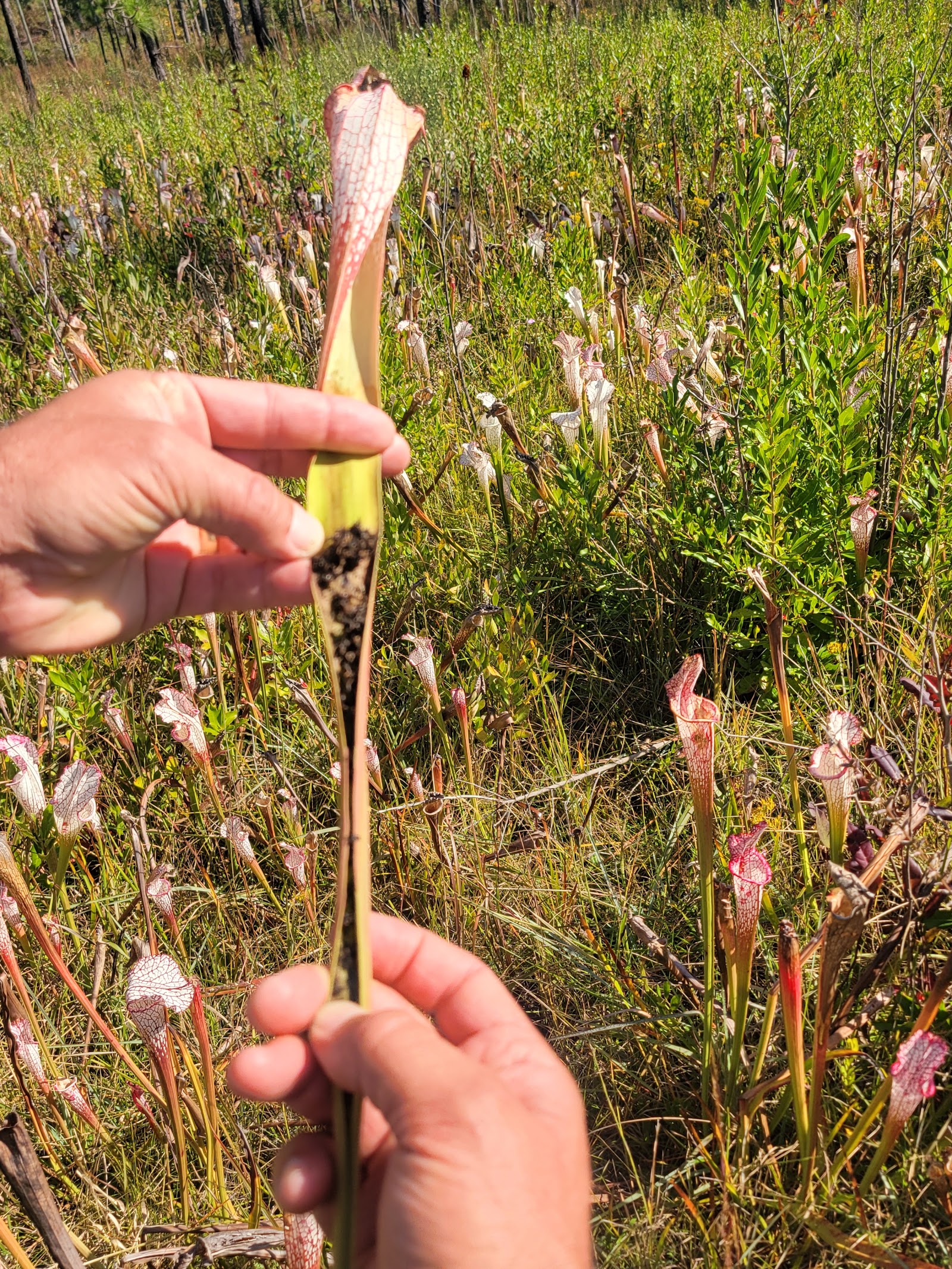
Inside the plant, a slick wax substance and downward-pointing hairs prevent insects from climbing or flying back out. Insects slide down into a pool of rainwater and secreted digestive enzymes and acids at the bottom, where they dissolve so the plant can absorb vital nitrogen and nutrients. It’s a remarkable natural balance: interconnected ecosystems rely on one another to build a vital life-support network—one that was close to extinction before conservation efforts saved it.

The longleaf pine forest that permeated the Southeast United States once stood at 90 million acres. As the country expanded and developed, pine forests were cut for saw timber, and other human land uses. Longleaf pine acreage was diminished to just 2 million acres by the year 2000. When organizations like the Longleaf Alliance were established to guide longleaf restoration, stewardship, and conservation using science-based outreach, partnership engagement, and on-the-ground assistance, there was a resurgence of longleaf pine forests throughout the Southern states. Today, it is estimated there are over 5 million acres of longleaf pine forests and that number is growing. It’s an environmental conservation effort heading in the right direction and gaining momentum.
Prescribed burns are an essential element of a healthy pine forest. There are many public and private forests managed and maintained through prescribed burns. The Nature Conservancy of Alabama works with both public and some private land owners to plan and execute prescribed burns. Rob Wood and his team of burn experts plan these burns, many which take place in state and national forests. Rob tells me on our walk that a prescribed burn in March will result in a spectacular vista of colorful pitcher plants and wildflowers in April, May, and June.
Pitch Plant bogs exist throughout the Scenic 98 Coastal area if you know where to look for them. Places like Weeks Bay Pitcher Plant Reserve, adjacent to Week’s Bay between Fairhope and Foley, has a beautiful boardwalk access leading to a pier on Fish River. The Betty Crawford Rainwater Perdido River Reserve is another pitcher plant bog on the Florida side of the Perdido River, just south of the U.S. Hwy 90 crossing. And, of course, The Mobile Botanical Garden’s Longleaf Treasure Forest is in the heart of Mobile’s Springhill suburban park region.
The Nature Conservancy manages and restores these native fire-maintained longleaf pine forests and wetland seeps, which faced restoration challenges following storms like Hurricane Sally. After Hurricane Isaias, I drove through the Conecuh National Forest near Andalusia, Alabama, which the storm damaged significantly. This is where conservation organizations like TNC, Forever Wild Land Trust, South Alabama Land Trust, and many others come together to determine which sensitive lands need protection and preservation.
Splinter Hill Bog Reserve is worthy of a “field” trip. Carnivorous pitcher plants have piqued the curiosity of gardeners worldwide, and Splinter Hill has attracted many to its mecca. In June 2026, the Royal Horticultural Society’s Head Gardener at the Garden Museum in London, Matt Collins, ventured to Splinter Hill Bog Reserve and captured the essence of it all in his beautiful article, Walking With Carnivores.
Andrew and Rob recently conducted a tour at the Longleaf Pine Treasure Forest at Mobile Botanical Gardens. This 35-acre sandhill pine treasure is the largest fire-maintained forest within the city limits of a major city in the entire 9-state coastal range of the Longleaf. Quite a feat, and a testimony to the courage and foresight of the political leaders of Mobile.
Thank you Andrew and Rob for my mid-week adventure. Below is a story written by Andrew Saunders, who was present at the first prescribed burn conducted by The Nature Conservancy at Splinter Hill Bog Reserve when it was first acquired. I hope you enjoy it
Burning Splinter Hill
By Andrew Saunders
Malcolm was the fire boss excluded from the real action of the day. Ornithologist, work-a-day ecologist, and frequent burn-crew leaderman, Malcolm undoubtedly drew the short straw among the several fire bosses on the big burn, and was assigned to mind the three of us observers.
Malcolm was to keep us on the high-ridge trail moving ahead of the converging fire lines. This role he assumed with affable good fellowship and competence. We stuck to our plan through the early excitement of the first ignition set as a head fire. He explained, “It’s meant to run with the wind toward the big creek bottom and die.”
With the large crew massed in a narrow neck of land for the first flaming, there was something of the feel of an athletic event. The initial header fire set by the creek was a prelude--a test that assured the rightness of conditions, and released the butterflies in the belly of the players.
Yellow, orange, red jump suits and hard hats flashed among the pines hither and yon as teams fanned out with fire cans, big-pronged rakes, and articulated shovels. Radios cackled. Various gear attached to each crewman from belts and lanyards swung and swayed. The gear had heft and bulk, but the crew was mostly fit and moved with grace born of experience. Much of the equipment appeared specialized and esoteric to the uninitiated. Malcolm explained the fire blankets and the pumper trucks and answered many of our other questions.
A four-wheeler buzzed the ridges as the boss of bosses surveyed his far-flung plan, and another four-wheeler crept along, spraying jets of flaming fuel at the operator's command. We watched all of this as our small team moved just ahead, and the scope of the event widened from the creek bottom to an expanse of ridges on each side of us.
The snap-crackle of the blazing switch cane intensified from a bottom to the east, but showed us no smoke or flame yet. She was likely backing up a near slope and burning clear in the morning’s brisk north wind. The sound was full of excitement and anticipation.
Well off our flank, we could see bright orange flames rising as tall as a man and moving slower than a slow walk. The radio reported growing confidence in the crew as wider fire lines advanced as predicted. All positions of defensive control appeared well-positioned.
This confidence influenced the mood of our observer group. The entire operation now felt more dispersed, and we were more to ourselves. We slowed our pace of advance to talk botany and geology as we identified bushy plants and examined sandstone remnants in the washes. Malcolm joined us as fellow nature-lovers in this revelry. His mantle of responsibility was light. We peered out over the ridges, some blackened and cleared now, and exchanged visions of the long-leaf forest of the future. We could begin to see it.
At the height of our revelry, we began to notice a line of flame advancing more rapidly. It was closing on our road 300 yards ahead, such that it would reach the road before we could cross to a forward position. Meanwhile, lighter wind conditions let smoke begin to build around us. We were cut off in billowing clouds of smoke.
“Not to worry,” assured Malcolm, as he snapped back to fire boss and calmly ordered our retreat to the safety of a blackened area at our rear. We hardly reached our point of safe retreat when the hazy lights of a crew truck appeared. The driver grinned knowingly as if he understood and forgave the reason for our dawdling, “Get in,” he said. “The boss wants you out of here.”
Thanks to “really big boss” Keith Tassin,
And to our fearless leader, Malcolm Hodges
And to the fine fire crews of The Nature Conservancy of Alabama & Georgia Chapters
Andrew Saunders
Splinter Hill Bog
Baldwin County, Alabama
February 11, 2005
More from
Day Trippin'
category